Fred Kaan‘s recessional text (actually Frederick Herman Kaan, thank you CWB) did survive into CWB II, but CWB used the commonly associated backing NIAGARA, which was replaced in CWB II with WINCHESTER NEW.
Hymnary lists 157 texts set to WINCHESTER NEW, none of which is this one, so now maybe CWB II’s editors are being creative – I know, Kaan was active in England and therefore should not exist in Hymnary’s orbit and although they do list many of his songs, they don’t have this one. Still, my brilliant theory that CWB’s odd choices were being smoothed out in CWB II has been shown to be untrue. New theory: maybe all editors of hymnals are organists who use the tunes they like and are familar with.
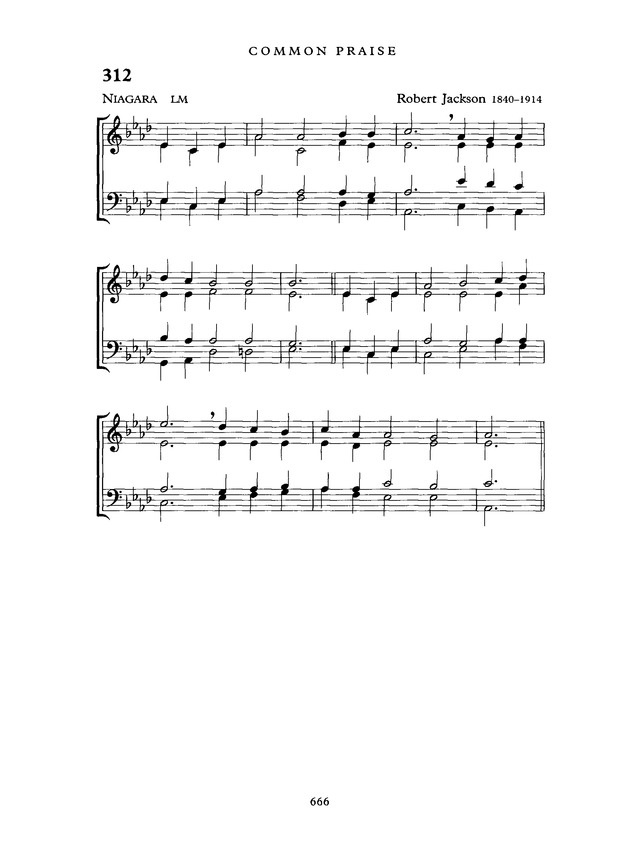
NIAGARA was written by Robert Jackson, who must not have had a middle name or they would have put it in. The version below is in Ab but CWB brought it down to G, thanks be to God.
The text is at Hope Publishing, where they suggest six settings none of which are either of these.
I cribbed the chords from the organ music at Hymnary for a backing:
Of course, now I can find a clip of the WINCHESTER NEW version from a CWB II parish in Brisbane – well done Good Samaritans.
The CWB2 editing board did have organists at it’s head. I’d say Mr. Bernard Kirkpatrick was at the head of this committee (his name appears the most in the book and he did typesetting). Various other musicians were involved with the Music Board, and at one point, our Diocese’s organist was on it. It all stems from the fact that Cathedrals are too echoey to make guitars sound good.
My theory is hymnal editors are all super biased towards music that they like and play well. A hymn book is just a person’s collection of favourite hymns, or something to sell to churches. As One Voice is a very different type of hymnal from CWB2, and I’m pretty sure organists weren’t very involved in the former…
CWB2 drew heavily from NLP, AOV, and TiS, as well as CWB1. Even carried over some of the unfortunate hymn edits.
Maybe if we can find out if any of the members of the National Liturgical Music Board had worked in american contexts will we know why CWB2 got a bunch of american tune matchings.