Blame Mary for this one.
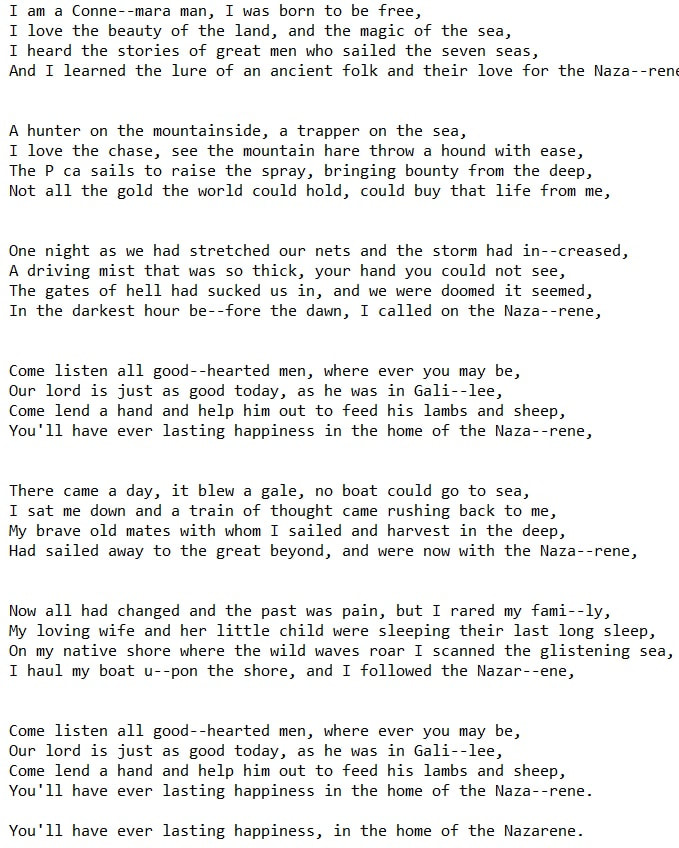
In the context of church songs that may have become country standards, she directed us to this song by Fr. Eamonn (Eddie) Bheartla Ó Connaighle. It is a proper Irish folk song.
The background for this is all at Godsongs naturally.
I love the version by John Beag Ó Flatharta, but I can’t see it working at our local church, except perhaps during the local Tamar Valley Folk Festival each January.
Godsongs has a link to the guitar chords and lyrics. There is also some sheet music there that is just wrong, both unsuccessfully trying to put an Irish lilt to the tune and also with many incorrect notes.
My backing is in E like the version above and I’ve made what corrections I could but I don’t vouch for their accuracy. I put a BIAB instrumental verse after the chorus.
This brings up the idea of what music can be sacred. Historically, sacred music was generally secular before it was taken up by the church, usually after enough of an interval so that the secular roots of the music have been forgotten. It is temporal, cultural and responds to the available technology. An enclosed community is ideal for chant. An organ is ideal for the long reverberation of a cathedral. A piano is great to support an assembly, as in good hands it gives melody, harmony, and percussion support. A voice plus guitar will work for small assemblies unamplified and large ones amplified. A voice plus a backing is better than listening to a CD or tape. All can be sacred if they arise from a worshipping community.
The Catholic church has a big problem in not being self conscious enough to notice the relativistic nature of its worship over centuries and cultures and the organic adaptations that are made adapting to technology, equipment, time, place and changing patterns of human thought and belief.
The style is irrevelant except that it needs to not cause problems with the liturgical flow of the mass. Since style is linked to instrumental accompaniment, each will have its achilles heel. For example, an overbearing organ that goes on too long or drowns out the assembly isn’t helpful. A drummer who hasn’t learned to play quietly or know when not to play at all has things to learn. Over amplified voices and instruments that discourage the assembly from participation must be avoided. The style may not be a problem but the sound system may well be.
Just because I don’t associate a certain style with being sacred doesn’t mean a particular assembly won’t find it exactly what is needed for their expression of faith. I could go on…
Now may be the time for my mega super awesome keyboard warrioring skills.
About Gregorian chant, there are 4 distinct categories that should be considered.
If we are talking about the ancient responses where the tunes never change, the Lord be with yous and Amens, they fit in almost every situation. They’re super easy to learn, and sound great everywhere. This is what we should be singing at Mass, well before everything else.
If we are talking about the Mass Ordinaries, they are very flexible for any space. From the super easy and sorta depressing (As you find in the Missal) to the easy and nice (most of them) and the difficult and interesting, you have options. Special shout out to the Ambrosian Gloria which is two notes for most of it and then every so often breaks out in a little joyful jingle. This category is the saddest to see lie forgotten. The ordinaries in the Graduale Simplex are easier and have some gems, but you can definitely live off Masses 4, 8, 9, and 11 from the standard Kyriale.
If we are talking about the antiphons and psalm bits that were memorised and sung by mediaeval monks, back when the culture was 110% church, it’s probably best to have some good singers who can handle it. Because that stuff can be HARD. Great to listen to, most are easy once you get the hang of them because of the church modes. Mostly we sing the texts to psalm tones, which are EASY.
The last category we may be talking about is the hymns, songs, and other lil niblets that we find at the end of the books, which don’t really come from the Mass at all. Hymns like the Veni Creator and Adoro Te, as well as the Marian ones like the Salve Regina or Salve Mater, are easy, popular, and work almost anywhere. They were usually found in the Liturgy of the Hours or during Adoration.
A small note on the organ: The Church is part of the instrument. Pipe organs are made with the church building in mind. Just as a piano uses a soundboard to amplify, just as our voice uses our faces to amplify, the organ uses the Church to amplify the sound. And that opens itself up to some really nifty allegorical interpretations on what the church is.
The pipe organ is not just for big echoey fish tank cathedrals, they are great in most spaces when installed properly. The cosy spaces work really well with some more compact organs, just as the bigger fancier ones work for larger spaces and more ambitious music.
Marty Haugen explains instruments better than me here: https://www.podbean.com/media/share/pb-2ct3y-1a42da8